Then & Now: Hāmākua Coast—Sugar, Landings, and Shipwrecks
By Pete Hendricks
The Hāmākua Coast from Hilo to Waipi‘o Valley is a 50 mile stretch of rocky shoreline, deep valleys, and imposing cliffs. Such a windward coast seems an unlikely place to find what was once the dominant industry on Hawai‘i Island, sugar cane.
With the demise of the sandalwood trade in the mid-1820s, whaling had become a mainstay of Hawai‘i’s economy. After the time of the first whaling ship Balena in 1819, the whaling business grew as Hawai‘i’s main commerce; not the catching of whales here, but winter escape from cold northern waters, taking on provisions, R&R for ship’s crews, and transshipment of whale products to eastern mainland ports. Up to 500 ships a season called in Hawai‘i, mostly Lāhainā and Honolulu, but for some years Kawaihae and Hilo saw 40 to 50 ships annually. The U.S. Civil War and increasing use of petroleum hastened the decline of whaling.
Polynesians had included sugar cane in their voyage supplies of live food plants to be grown in a new home far to the North across the equator. The plant was known for its sweetness as well as believed medicinal properties. Sugar was one of the plants the resourceful voyagers were able to keep alive in voyaging canoes over great distances for weeks at a time. Sugar cane was a common part of Hawaiian settlements when the first outsiders visited. There were apparently early Hawaiian specialists in the crop, referred to in Papa I’i’s Fragments of Hawaiian History as “the men who cultivated sugar cane at Pu‘u Pueo in Manoa under Kekuanaoa.”
Immigrants to Hawai‘i in the early 1800s saw the commercial potential of sugar and began the first sugar mill on Kauai in 1835. By 1836, the Sandwich Island Gazette reported: “Sugar has been sent from the islands, and sugar plantations are starting up with great success.” However, early commercial sugar operations faced water shortages, limited labor, and isolation from markets. Expansion of sugar operations later paralleled technology with the introduction of massive irrigation systems, steam power, and railroads.
For Hawai’i Island, commercial sugar cultivation grew first in the Hilo area and Kohala, as both had access to relatively calm water ports at Hilo bay and Mahukona. Seven plantations started between Hilo and O’okala between 1850 and 1875.
Further sugar expansion up the coast included a series of small landings. Typical in the mid 1800s was a small concrete platform at the base of a cliff, with a derrick for transferring freight and personnel from shore to ship and back. Inclined railways and roads made the connection between landings and sugar mills.
Illustrating the difficulties of working at the Hāmākua land-sea interface is the Marine Disaster column of the June 8, 1878, Pacific Commercial Advertiser: “We regret to chronicle the loss of the schooner Caroline Mills, near Honoka‘a, Hawai‘i, on the 28th. Her freight was all lost, and the vessel herself is a total wreck. This is the second vessel that Reed & Sisson have lost; the first being the Fanny, which was wrecked about three months ago at Punalu‘u, Ka‘ū.” In fact, Caroline Mills had just come from California to start inter-island trade in Hawai‘i. In a lawsuit heard later in California, the judge ruled in favor of the Swiss Lloyd Insurance Company; that the Captain knew the anchor chain was weak but added a hawser (large rope) and still tried to anchor in marginal weather. High seas and heavy weather are not uncommon on the Hāmākua coast.
The approval of the Reciprocity Treaty between Hawai‘i and the U.S. in 1876 gave Hawaiian sugar tariff-free entry into the mainland market. The business community strongly supported the treaty and had been lobbying since the 1850s for its passage. King David Kalākaua was also strongly in favor, and even made a trip to Washington D.C. to support it, including an address to a joint session of Congress.
“To aid in the development of the resources of the Kingdom,” the Hawaiian Kingdom Act passed in September, 1876, and resulted in the appointment of a Commission which visited Hawai’i Island in February, 1877. The Commission made numerous recommendations on agricultural expansion from Waipi‘o Valley south along the coast. “The District of Hāmākua may become a most productive district. In commenting on lands, we have spoken of them as sugar lands, as that will doubtless be the staple product; but there is almost no land that is not cultivatable, and everywhere the fruits of the tropics and many of the temperate zone can be raised.” The stage was set for explosive growth for the sugar industry.
Over on the coast of California, rapid growth of the San Francisco Bay area during the Gold Rush decade 1850 to 1860 brought great demand for building materials. Lumbermen began to exploit the redwood forests immediately north along the coast. Sailing schooners put in at small coves to pick up the lumber. These plucky little ships were called “dog hole schooners,” as they entered coves along the rugged coast where it was said only a dog could turn around. The first contraptions were lumber chutes, suspended from A frames dangled over the cliffs. A man riding the gear would direct the chute to slide lumber on to the deck of the ship. Later a more efficient method was developed, using a wire connected to a mast of the ship to load lumber and offload supplies. Steam power soon replaced oxen in the forests and coastal lumber mills.
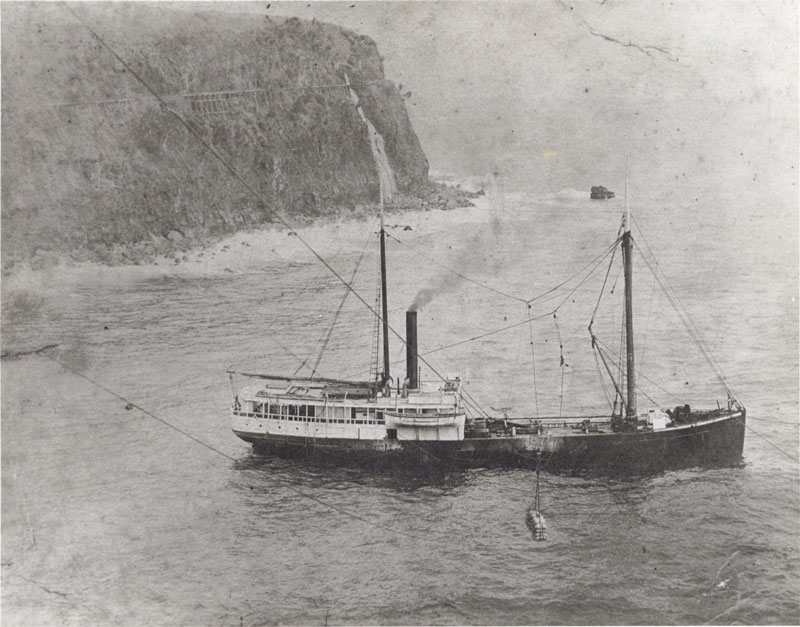
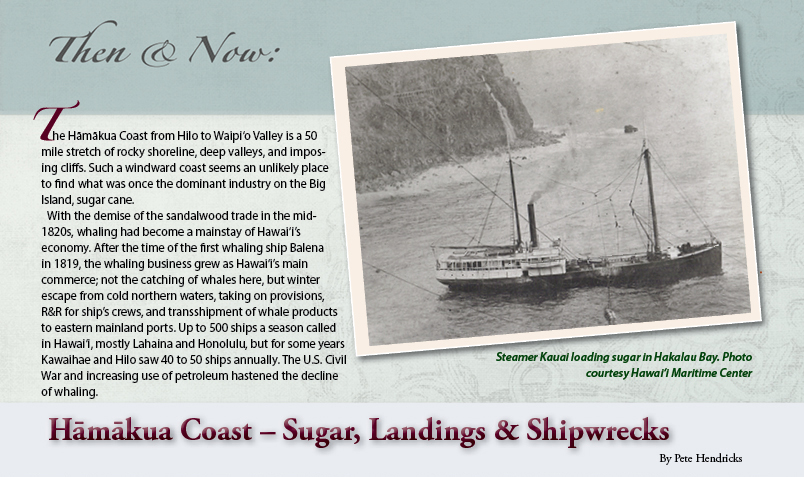
In Hawai‘i, wire cable landings soon appeared along the Hāmākua coast with the rapid expansion of sugar plantations in the 1870s and 1880s. Kukuihaele landing was to be the highest, at 240 feet above the ocean. Steam power supported commercial expansion, both in the mills and fields and for small steam “donkey engines” at landings and on shipboard.
Permanent moorings were placed and maintained so ships could hold in place for cargo transfer. Eventually the main cargo wire was attached to a mooring out past the ship; the main wire was controlled by the men in the cable warehouse on the cliff and the trolley and cargo carriage was controlled by the ship’s crew.
Smaller ships would leave Hilo in the dark and load sugar from the Hāmākua landings in daylight. Cargo was then transshipped on larger ships for delivery to San Francisco. There was even an East Coast sugar fleet, with sailing ships up to 3,000 tons, which hauled sugar from Hawai‘i to eastern North America.
Improvements in technology continued into the 20th century. A 1907 annual report of Paauhau Sugar Plantation Company stated: “A new cable landing has been installed during the year and is now in operation, doing excellent work. It is a decided improvement over the old method of handling sugar and freight in small boats on our dangerous rocky coast.”
Even with the addition of auxiliary steam power to ships working the Hāmākua coast, the sea still took its toll. One of the larger ships, the bark Klikitat, was lost just outside Hilo Bay on her departure to the mainland in 1912.
With the opening of the Hāmākua railroad line in 1913 from Hilo to Pa‘auilo and road improvements along the coast, the Hāmākua landings were less important. However, as late as 1958, Honoka‘a Landing, for example, was still pumping molasses and receiving fuel from Matson ships moored below its cliffs.
Relatively few losses of ships and men is a tribute to those who worked to develop the transportation and cargo system along the Hāmākua coast. The Hāmākua plantation system owed its existence in its early years to these skilled and resourceful amphibians.