The Mysterious World Beneath Our Feet: A Fascinating Exploration of the Worldʻs Longest Lava Cave
By Noel Morata
Walking through a stretch of pristine forest filled with ‘ohia, large native hapu‘u ( tree ferns) and beautiful bamboo groves is a nice hike in the Puna District of Hawai‘i Island. However, that’s not our destination today. Eventually, we approach an opening lined with short ladders, which we climb down to the entrance of Kazamura Cave. It’s the beginning of a trek into the dark depths of a lava tube. There are many lava tubes formed all over Hawai‘i Island and this is the longest and deepest lava tube known in the world.
Kazamura Cave, formed some 600 years ago between the years 1410-1470, has been surveyed and runs over 40 miles in length from the Kilauea caldera down to the ocean in Hawaiian Paradise Park, while dropping over 3,600 feet.
A trip covering the entire length, from the upper entrance near Hawai‘i Volcanoes National Park to the lowest entrance in Hawaiian Paradise Park takes two days. Such a trip includes 17 rope drops and 50km of traverse. There are more than 101 known openings into this lava tube, and several operators offer tours of this significant cave. Harry Shick, owner and operator of Kazamura Cave Tours and author of the book Understanding Lava Tubes and Lava Caves, is our guide for this tour, which covers approximately one mile of the cave without any drops. Still such an adventure takes five hours.
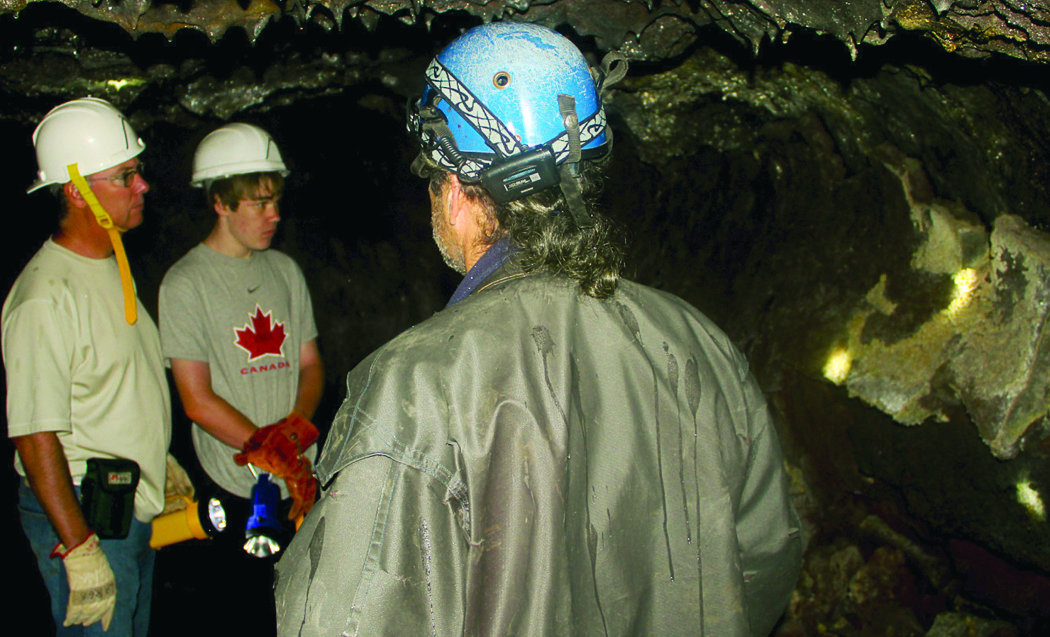
Hard hats, gloves and flashlights are necessary gear for exploring the pitch-dark tube. “Everyone should be wearing gloves for protection and also to make sure that there is no contact with the walls which leaves residue from our hands if unprotected,” says Harry.
Lava tubes are formed as the lava flows downhill and the outside walls build up, creating a hard crust that forms and cools faster than the center, which is still hot and flowing. “In time this hard crust thickens and forms a continuous conduit that we know as a lava tube,” Harry states. “Lava tubes are very active for long periods of time and can also become enlarged by the abrasive and fluid flow which eats away at the harder crust.”
It’s very dark inside, and we descend two sets of simple-rung staircases with no guardrails and only a flashlight illuminating the stairs. The first segment of finding our way in the dark and then climbing into a deep well into the bowels of the cave makes it a challenge to the senses. A novice cave explorer, my sense of space in the dark is completely distorted and I feel the adrenaline rushing while making this quick descent into the lower levels.
Once we are at the bottom, it takes a little time to adjust to the complete dark even with our small flashlights. One can immediately sense a feeling of being very small and being a minute speck compared to the time frame of this lava tube’s formation. Harry immediately focuses the light on some geologic features like lava-cicles, (lava droplets on the ceiling which are comparable to small stalactites), and many other features like lava spires, skylights, scallops, straws and lava falls. Many of these features are unique and only found in lava tubes. Fortunately for most of us starting to glaze over from the information overload, Harry pulls out his camera and shows us the amazing insects that can live in the dark caves. These include spiders, centipedes, brown moths, earwigs, grass hoppers and millipedes. He also mentions that even animals like dogs, pigs and mongooses have accidentally fallen into some of the openings.
We continue traveling through the tunnel into some smoother walking areas and Harry explains how the caves were used in the ancient times by the Hawaiians. “The Hawaiians used these caves for many purposes including everyday activities like collecting water, growing food closer to the openings, storing food, using the caves for burials and even living in certain sections,” said Harry. “These caves were also used for defense from rival attacks, for hiding out and also for places of refuge where the kahuna or priest would absolve a native when they broke a kapu [everyday rules for the community to obey]. Once the kahuna absolved them of the kapu, they were allowed back into the community.”
The group traverses to deeper levels and we see more unique formations like crystals, more lava-cicles and even lava tubes within lava tubes. We climb up a large ladder (over 21 feet) and then we each climb up a small lava fall with an attached rope securely tied at the top. The lava fall is a formation that drops in elevation from one lava floor into a lower level when the lava eventually starts to recede. You can actually see how the lava fall was formed, and the dribbles of lava fall into stalagmite-like formations, which are called lava dribbles. We approach many sections where the tube becomes tight and the ceiling is filled with rough surfaces and the ever-present lava-cicles. Harry warns us to scrunch down in some of the tighter sections (feeling like we’re on an adventure of going into more uncharted areas).
At one point closer to the end of our hike, we are instructed to turn off our flashlights and be silent. The sudden turn to pitch black gives a feeling of being completely lost in the dark with no way out; it’s an intense and eerie feeling. Fortunately, that small exercise was very quick and we turned on the lights for our hike back, which seemed to go faster since we were familiar with the layout. In no time we approached the first two ladders leading to the cave entrance and slowly took turns to climb back to the top. Seeing light at the opening of the tunnel was intense. After being in pitch black, it was hard adjusting to the brilliant sun.
During the slow walk back through the jungle to the parking area, I had a chance to adjust to being above ground and reflect upon the immense, mysterious and magical underworld only a few feet beneath my footsteps. ❖
Resources
To find out more about the tours, check out Harry’s website at www.fortunecity.com/oasis/angkor/176/. There you can also purchase his book, Understanding Lava Tubes And Lava Caves.
On the island’s west side, Kula Kai Caverns offers a similar tour and educational experience in a large lava cave that is easily accessible. Guided tours are offered in easy or challenging levels. Visit www.kulakaicaverns.com or call 929-9725.
Contact writer Noel Morata at emorata@yahoo.com

Noel Morata
Noel resides in Orchidland, a subdivision in Puna. He loves living on the east side and being an active participant to all the amazing music, diverse cuisine, culture, history, and simple pleasures of living on our beautiful island. He enjoys doing photography and dabbles in various fine art mediums including ceramics, acrylic, and watercolor. He also works occasionally on video projects and freelances for Ke Ola Magazine. There are so many interesting people and places in Hawaii and he loves share wonderful stories about this special island.