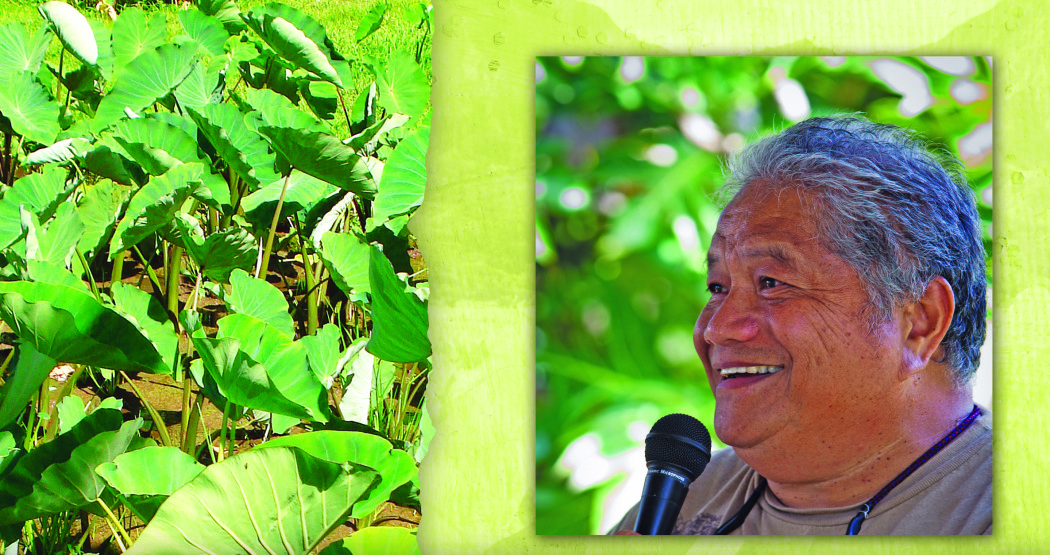
Taro, ‘Ohana and Jerry Konanui
By Marya Mann
Lau or Lū’au ~ Leaf
Turning over a new leaf this magical year of 2012?
Think of making that a taro leaf. For a taste of the divine, simmer it into a soothing soup with coconut cream and garlic, or place cooked taro corms into a Manapua for a savory new delight. The word, lū‘au, in Hawaiian, is the name of the top of the taro (kalo) plant, the leaves, or a dish made from them. Because it’s often served at feasts, the name became commonly used for the feast—lū‘au.
Taro’s heart-shaped leaves and plump bodies have a magical past we don’t often associate with a simple herbaceous plant. Legend says that taro is the elder brother of humans. Two siblings in harmony, taro and us. Nature feeds and sustains humanity. We, in turn, cultivate and care for nature.
Easy. Natural. Nutritious.
The mainstay of the healthy Hawaiian diet since Polynesian voyagers brought living taro starts to these shores in canoes 1,700 years ago, taro does more than nourish the people—it can save lives, nurture aloha and form a foundation for present and future food security.
In 1991, taro ascended to a kind of rock-star status among doctors and scientists as a weight-loss miracle after 19 women lost 17 pounds in 21 days on the Wai’anae Hawaiian diet. (See sidebar.) But Hawaiians have always known taro’s allure.
Makua ~ Corm, Parent
“There’s much much more to it than just putting food on your table,” says Uncle Jerry Konanui, the eighth-generation taro farmer and proponent who knows as much about taro-culture as anyone alive today. “Eating well is the result of good practice, hard work, and knowing what to do. It is also about tuning in. You have to know your environment, your ‘āina, the climate, the seasons and you have to know what surrounds you both near and afar.”
Whether you are a farmer feeling the mud between your toes as you nurture the taro in lo’i—taro patches similar to rice paddies—or neighbors at a pā’ina (potluck), the ‘ohana is at the heart of taro cultivation and preparation.
We are a “culture of sharing,” says Jerry, recalling his earliest memory of “waking up in my grandma’s taro patch. She babysat me and I would be sleeping on a raised platform in the field, lauhala mat for a bed, a roof for shade from the sun and protection from rain.” Surrounded by the sounds of rain in water-catching metal drums, he would awaken, see her weeding and call out to her. Then she would feed the child with nutritious poi, as Hawaiians have done for centuries.
Taro, the elder brother in Hawaiian legend, came from the first-born child of Wākea, the sky father, and Ho’ohokukalani, the daughter of Papa, the Earth, but it was stillborn. Where Wākea buried the child, a plant sprang up. It was named
Hāloa-Nakalaukapalili—long stalk with leaves quivering—the first taro plant.
The second-born of Wākea and Ho’ohokukalani was called Hāloa, whose kuleana (responsibility) was to care for his elder brother, taro—Hāloa-Nakalaukapalili. As a human, he is considered the progenitor of all peoples of the Earth, and taro is our elder brother. The word Hāloa, meaning long stem, represents the long stem of the taro plant, the symbolic stalk connecting human and divine. Hā—breath of life—and loa—long —make Hāloa—long life.
Reflecting family relationships, the taro plant is described in metaphorical Hawaiian words that imbue a sense of ‘ohana throughout taro growing, preparation and eating, a comforting sense of the continuum of love and slow, steady nourishment.
“It’s called breaking bread together—‘ai pono,” says Jerry. “Instead of dropping the kids off for some McNuggets, when a family grows, prepares and eats their own food together, the root-stalk of the group grows strong.”
The taro huli planted in the ground is the makua, parent or ancestor, the stable foundation of the family. From the makua sprout ‘oha—offshoots, keiki, children of the mākua. Many keiki forming together with the mākua become ‘ohana.
Concerned for the fate of taro, Hāloa, long stem of humankind, regional taro farmers have united with Jerry to form another kind of ‘ohana, ‘Onipa’a Na Hui Kalo, whose mission is to maintain the purity of taro. Many among them credit Jerry with being the “real deal, a Superman,” a one-of-a-kind resource who has travelled the world to help save this mighty Hawaiian elder brother taro from becoming a “Frankenstein food,” an unnatural version of itself.
‘Ohā – Offshoot, Keiki or Child
In the last several decades, global companies like Dow AgroSciences, Monsanto, Syngenta Seeds Inc. and Dupont’s Pioneer, have moved into Hawai’i with “transgenic” crops which modify the genetic code of plants. With little public discussion, Hawai‘i became a world leader in open field testing of genetically modified organisms (GMOs), and no one knows what the long-term effects may be.
Nancy Redfeather of the Kohala Center recalls that in 2002, she and a group of Kona women, mothers and organic farmers decided to take on the GMO issue in Hawai’i. Studies had already started to show what’s been proven a decade later: that NO level of GMO is safe for human consumption. She feared that genetically engineered foods would devastate the food chain.
“We looked around for Hawaiians to join us,” says Redfeather. “The issue of seed sovereignty seemed like a natural fit for
Hawaiian farmers. Jerry seemed like a likely candidate but at the time he was working with University of Hawai‘i Manoa (UHM), and was supportive of this new technology. His hippy friends had been telling him about this (GMOs), but he was not convinced that there was a problem.”
When asked to take a stand on GMO from friends on both sides of the issue, Jerry said, “I can’t, I don’t know what is wrong with GMO, I need to know more.” His plea for help was answered by an invitation to attend a New Mexico gathering of indigenous peoples, where GMO effects on human and ecosystem health were at the forefront. Jerry learned that unpredictable biotech methods could lead to toxic carcinogens. Rats fed GM potatoes had pre-cancerous cell growth and gastric problems.
Jerry couldn’t believe it. A perfectly good, natural, life-saving edible corm was being sacrificed for a monstrous Franken-foods experiment in genetic modification that would diminish the
spectrum of more than 300 varieties of taro grown here in Hawai‘i. Impossible!
Not satisfied with that one conference, Jerry attended Terra Madre, the Mother Earth Conference, sponsored by the Italian Government, an event held every two years. Five thousand people and experts from 150 countries convened to acknowledge that global GMO technologies give corporations control over our food production.
Jerry became convinced that genetic uniformity restricts a species’ natural ability to evolve. Once you freeze its evolution, it’s a sitting duck for pests. Thus, monocultures need corporate chemicals to protect them. Toxic chemicals have lethal impacts on health, culture and land, but worst of all, GMOs give ownership of food and life forms to corporations.
GMO taro would mean that corporations could own Hāloa-Nakalaukapalili, the Hawaiians’ elder brother. The Hawaiian worldview of balanced, cyclical systems and a culture based on ‘ohana was the antithesis of the corporate ownership and narrowing of genetic possibility.
“He called his friends at UHM and University of Hawai‘i Hilo and told them that he would be traveling in another direction from now on,” says Redfeather. “That was the beginning of the bridge that was built between the Hawaiians, the farmers, and all the concerned citizens of Hawai’i.”
Through peaceful means, he shifted himself from being an eighth-generation kanaka maoli farmer in favor of GMOs to becoming a voice for sustainable agriculture around the world, a defender of our future food sources from biotech abuse.
Truly, elder brother is his kuleana.
Huluhulu – Roots
Sprouting wild along tropical riverbanks or planted in terraced fields, taro grows easily in dry or wet soil in 65 countries. Taro was at the center of Old Hawaiian culture, fostering the aloha lifestyle, its seasonal rhythms, the cycles of planting and harvesting and an understanding of natural laws through a sophisticated system of succession planting. Farmers from Puna and Ka‘u have names for seven generations of taro produced from one planted huli, the makua.
“Kalo (the Hawaiian word for taro) is the center of my universe,” says Jerry, “where every facet of life is revealed and practiced, where our Hawaiian values lay within. Many look at a mahi’ ai or a hula dancer and say that’s all they are, but the true fact of the matter is, whatever the practice is, it contains all the components of the universe.
“You have to be everything in order to succeed in it and that means a multi-disciplinary scientist, a naturalist, an environmentalist. As well, you have to know yourself completely so that you can embrace your immediate surroundings as well as the afar surroundings that you cannot see. You have to know, it was how our ancestors survived.”
Hā – Stem
Inspired by hard work and staying true to his principles, Jerry’s wisdom has attracted apprentices and students like Noa Kekuewa Lincoln, a Stanford University scholar who works at the Amy Greenwell Ethnobotanical Garden.
“I was born and raised in Hawai‘i, by a moderately but not staunchly Hawaiian family,” he explains. “I was just always too haole….too white, too smart, too sober, too whatever to fit in properly. This continued through my time at Kamehameha [School], and when I returned from college on the East Coast the feeling changed from being misunderstood to being
downright ostracized.”
Trying to find his place in a changing Hawaiian culture that seemed to reject him, he began working for the Greenwell Garden, immersing himself in Hawaiian plants for consolation. That’s where he saw Jerry’s impassioned workshops on kalo and slowly came to know him.
The Jerry-moment that changed his life and world view was at Pu’ukoholā, where the taro-master had helped install a small mala (dryland garden). “Jerry was his usual jovial self, and the ensuing discussion . . . was interesting and inspiring, but nothing out of the ordinary to me. Then it happened. Lo and behold, this Hawaiian kalo farmer, this respected kupuna, this keeper of Hawaiian knowledge whips out a pair of reading glasses and begins to take detailed measurements and notes on the sweet potatoes
growing there.”
Jerry meticulously measured hundreds of leaves and stems, recording details from direct experience, in the classic scientific method. In that moment Noa realized that, despite resistance from the different cultures, his local peers and others, “there is not only a need, but a true desire to understand more. This moment went far in providing me with a certain confidence,” he adds.
“He (Jerry) was just one of those people that everyone pointed to as a source for knowledge,” says Kawika Winter, now Director of the Kaua‘i Limahuli Garden and Preserve, who was a UH student at the time he met Uncle Jerry 10 years ago. “For the vast majority of us . . .who had dedicated their lives to reawakening Hawaiian traditions, there existed a generational disconnect—a break in the line of traditions on one level or another (and sometimes several). But here was a man, a young Hawaiian-elder, who lived it, who learned it straight from his elders—one of the last.”
Pua – Flower
The events, campaigns, and tireless teaching by Jerry and his wife Gladys, at taro festivals, public presentations and talks across the state, fueled understanding about the dangers of genetic alteration of plants and foods.
Still, the battle took seven years. In the end, the Hawai‘i County Council passed a No-GMO Taro/Coffee Moratorium. Maui County soon followed Hawai’i Island’s lead by banning GMO experimentation on taro. Supporters argued that taro, a sacred plant and staple food for Native Hawaiians, should be kept secure in its natural and pure form.
But the Hawai’i State Legislature refused to ban GMOs altogether or even to tighten restrictions. In 2008, they did establish the Taro Security and Purity Task Force. The Office of Hawaiian Affairs funded the Task Force for two years to gather input, concerns and potential solutions from taro-growing communities on all islands.
The 108–page report entitled “E ola hou ke kalo; ho’i hou ka ‘āina lē’ia” – “The taro lives; abundance returns to the land,” distills the collected wisdom of taro farmers, agencies and UH representatives. Until 2008, it was precisely this local perspective which had been missing from the table, according to the Task Force Executive Summary.
While letting a field go fallow may be a useful agricultural strategy, lying fallow politically when corporations are moving to bio-engineer essential food sources is not enough. Monsanto and other companies have thousands of Hawaiian acres planted in genetically modified crops. A bee or butterfly doesn’t seem to know the difference between GMO and non-GMO plants, and farmers and activists are worried because genetically modified crops crossbreed with organic crops.
Mōhala or ‘Ao lū’au – New Leaf Rolled Inside Groove of Youngest Leaf
“It’s not one single solution,” says Uncle Jerry. “Aloha is the driving force. It’s the only cure. A guy who abuses life, and then has a granddaughter, that triggers something in him deep down. Maybe that’s the one that turns the tide. On a new leaf, on
new life.”
Piko – Where Stem or Hā Joins Lau
Taro, kalo, dasheen, eddoe, elephant’s ear, arvi leaves, West Indian kale, Colocasia esculenta—in any language, taro remains the star of the Pacific Rim. Generations of humanity have feasted on it, rested on its broad purple chest.
Thriving in māla (field) and lo’i, quivering with heart-shaped leaves, taro might be our life raft, in the future as it was
in the past.
In a botanical version of Noah’s Ark, taro has no match.
Contact Writer Marya Mann at marya@loomoflove.com
RESOURCES
Hawai‘i Cooks with Taro by Marcia Zina Mager with Dr. Alvin S. Huang and Recipes edited by Muriel Miura, CFCS (Mutual Publishing, LLC, 2006) Find some entrées and desserts mentioned in this story here.
The Wai’anae Book of Hawaiian Health: The Program Manual by (The Wai’anae Coast Comprehensive Health Center, 1993.
Facing Hawai‘i’s Future: Harvesting Essential Information about GMO’s, (Hawai’i Seed, 2006) Co-written by Nancy Redfeather and Elisha Goodman, among others. Available at www.hawaiiseed.org
Terrific Taro Recipes:
Comfort Food for the Future
Like giant potatoes, a taro is a dense, starchy tuber with brown skin, but inside the taro’s flesh may be white, pink, yellow, cream or purple. A good-quality taro corm will be firm and dense, but a word of caution: taro corms and leaves contain calcium oxalate crystals which can irritate the mouth, throat and skin. Wear gloves when handling raw taro. Cooking thoroughly inactivates the stinging crystals.
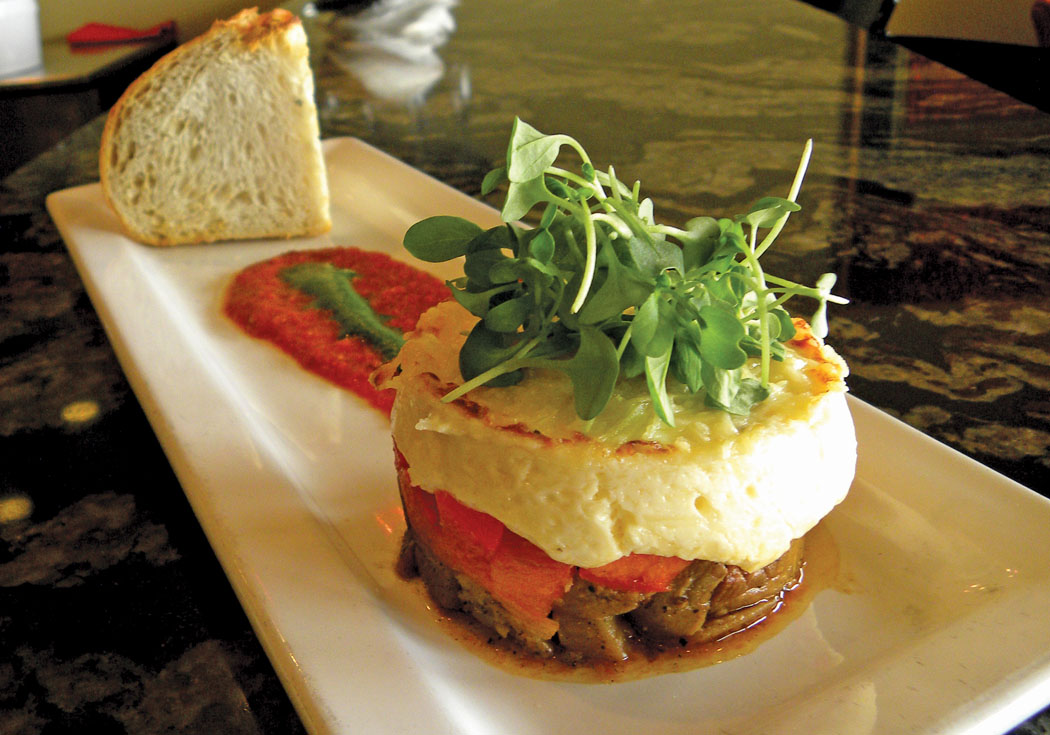
Taro, when served, can have a creamy consistency with the rich taste of a comfort food, as you’ll find with these simple recipes.
Taro Chips
Makes about 2 cups
2 large taro corms
Coconut oil for deep-frying
Sea salt
Scrub raw taro corms (wearing gloves) and boil in water to cover for 40 minutes or until fork-tender, but not mushy. Cool, peel, and chill thoroughly. Slice into paper thin slices. Deep fry in oil heated to 380o F. Drain on paper towels and salt generously. Eat while hot or freeze for later use.
Coconut Taro Curry
Serves 4 – 6
3 T. coconut oil
1 t. black or brown mustard seeds
1 tsp. garlic, crushed
¼ t. ground chili pepper
1 medium yellow onion, chopped
2 t. fresh or ground ginger root
2 t. fresh or ground turmeric
1 t. ground coriander
½ t. ground cardamom
2 taro, chopped
1 can of coconut milk (13.5 oz.)
1 t. sea salt
2 T. maple syrup or ¼ cup apple juice
1 T. lemon juice
Optional: ½ t. curry powder and/or 1 – 2 T. Patak’s Curry Paste (mild, medium or hot)
1. Steam taro for 40 minutes. Cool enough to peel. Set aside.
2. Heat oil in large pot or frypan.
3. Add the mustard seeds and cook them until they begin to pop. 4. Stir in garlic, chili, onion, ginger, turmeric, coriander and cardamom (OR in lieu of individual spices, timesavers can use 1 – 2T. of Patak’s Curry Paste).
5. Add cooked, chopped taro.
6. Put a lid on the pan and steam for a few minutes until the
vegetables are tender.
7. Add coconut milk, lemon juice, maple syrup or apple
juice and salt.
8. Let simmer a few minutes until flavors merge and serve by
itself or over brown rice or quinoa.
University of Hawaii recipes
www.hawaii.edu/hga/Lessons/maui98/TARO/trecip.htm
Polynesian Cultural Center Recipes
www.hawaiiforvisitors.com/ recipes/ pcc-taro-rolls.htm