Saving the Nightingale: Four-Legged Coffee Farm Workers Now Unemployed and Endangered
By Margaret Kearns
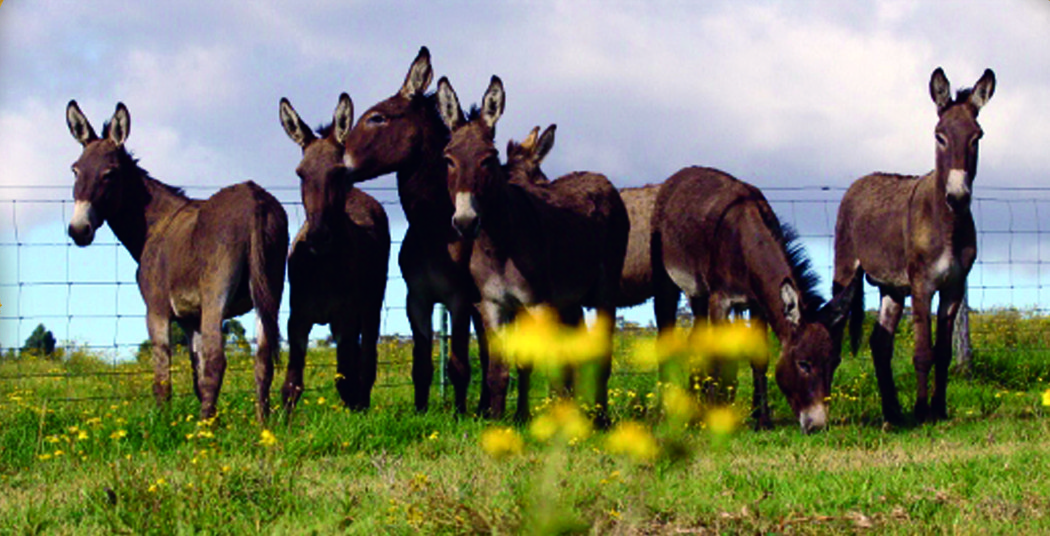
One of Hawai‘i Island’s most charming creatures—known as Kona Nightingales—played an integral role in island heritage, especially in the history and development of the island’s Kona coffee industry. These beloved donkeys bray from farm to farm at sunset, and their nickname derives from their “song.” Descendants of these hard-working beasts have been unemployed for decades. Following World War II, motor vehicles and equipment, together with surplus Army Jeeps, replaced the donkeys. Modernized vehicles took over hauling and other chores, and today you’re more likely to find ATVs—far more efficient and cost-effective than maintaining donkeys—doing the Kona Nightingale jobs on island coffee farms.
As a result, these now-feral animals freely roam West Hawai‘i’s arid lava fields. It’s an environment Waimea veterinarian Brady Bergin of the Aina Hou Animal Hospital says is perfectly suited to the donkeys. “These are hardy, sure-footed animals that not only survive but thrive in these areas,” he said. “Limited forage keeps their weight in check, constant movement keeps them fit and the rocky soils keep their feet trimmed.”
However, with housing and resort development in the Kona and Kohala regions, large parts of the once-isolated lava wilderness are now home to residential communities, golf courses, resorts, shopping centers and even schoolyards. Many of these homes and facilities are located in direct line with the donkeys’ well-traveled foraging routes: donkey “roadways” programmed into their “hard drives” from generations of predecessors who traveled the same paths. It’s a situation, Dr. Bergin emphasizes, which is neither good for humans nor the donkeys.
A recent aerial survey confirmed a feral donkey population of up to 600 in the Waikoloa region of the island alone. Dr. Bergin says, “It is a big problem. The numbers have been growing year after year, and the resources in the area (food and water for the animals) are not sustainable for a large herd such as this.”
Even during a year of abundant rainfall, such as 2011, the donkeys continue to feed in the backyards of residents in Waikoloa Village, the golf course and schools, he said. Beyond damaging landscaping, frightening children and creating public health issues with waste littering the populated areas, the donkeys’ presence on neighborhood roadways and the upper highway presents serious danger to drivers and donkeys alike. In fact, the significant increase of donkeys on the move in Waikoloa prompted the posting of electronic signs warning motorists of the threat.
In an effort to diminish the dangers, Dr. Bergin has recently teamed with the Humane Society of the United States (HSUS) and rancher Stan Botielho of Waikoloa to work at keeping the island’s donkey population in check. An underlying reason for the effort, he shares, is an attempt to avoid other possible solutions such as eradication of the herd and/or its relocation to mainland sanctuary locations.
A native of Hawai‘i Island, Dr. Bergin is passionate about preserving manageable herds of the Kona Nightingales here on the island. “They are part of our history and culture…literally part of the landscape of the Big Island. To lose them would be a huge loss,” he says.
Inga Gibson, Hawai‘i state director of the HSUS agrees, adding, “Ideally we would like to keep the donkeys here on Hawai‘i Island by locating a property where they can be safely and humanely housed in a sanctuary-type environment. That would be the best option.”
According to Dr. Bergin, their effort is not the first committed to the cause of keeping Kona Nightingales safe and at home on the Big Island. In 1995, a group was formed, headed by Fred Duerr—then general manager of the now-closed Kona Village Resort—and worked eight years to come up with a solution to save the wild donkeys. Known as the Donkey Committee, the group’s initial plan was to create a large, fenced pasture on the mauka side of Queen Ka‘ahumanu Highway across from Kona Village Resort and neighboring resort developments. That plan failed when attorneys for long-term leaseholders who controlled the land advised against it based upon liability issues. The concern was based on the consequences should donkeys escape the paddock, cross the highway and cause traffic accidents. Government agencies, contacted by the group at the time, were also reluctant to take action based on similar concerns. Without a paddock for safe keeping, one fatal accident (killing both donkey and motorist) did occur in 2003 on the highway fronting Hualalai Resort, and many other collisions with donkeys have been recorded over the years, including at least one additional fatal accident.
The Donkey Committee did proceed with a secondary plan to capture and adopt out individual members of that area’s herd of about 35 donkeys to private homes. Dr. Bergin is convinced that at least a portion of that herd was re-located to mauka uplands in the Waikoloa area, contributing to the growing population of Nightingales in that region.
Today, once again, a key goal for all involved in the donkey rescue effort is identifying available State lease land that could be used to maintain and sustain the wild donkeys safely in their native environment and/or finding private landowners willing to donate land on a permanent or long-term lease basis.
In the meantime, with assistance from Botielho and HSUS, Dr. Bergin has been successful in trapping and castrating some 200 adult male donkeys (known as Jacks) from the Waikoloa herd over the past several months. Land provided by Botielho as a temporary staging area throughout this process has played a key role in making this possible, according to Dr. Bergin.
“Without Stan’s generosity in providing the land, water and feed we would have no way to hold the animals for castration and provide a secure space following the procedure for recovery. The land also provides us with an option to simply release all of the animals back out into the Waikoloa area. With a secure and safe holding area, we have time, too, to get some of these castrated males adopted and relocated to new homes on private ranches island-wide,” he says.
Meanwhile, the HSUS is continuing its work to bring visiting teams of equine veterinarians to the island to assist Dr. Bergin with the actual surgeries. Dr. Bergin continues to be the main force in championing the cause, however, donating his time and, until recently, paying for the anesthesia and pre-and post-op medications out of his own pocket. The HSUS is now providing some funding to help cover these costs. Other fundraising efforts have included the Waimea Art Council’s month-long art show in May of this year, hosted at Firehouse Gallery, which featured the work of many Hawai‘i Island artists, photographers and fashion designers, with all profits donated to Dr. Bergin’s donkey rescue efforts.
“Since the donkeys are not under the protection or jurisdiction of any local or state public agency nor protected under federal law as endangered wildlife or native species, we currently depend solely on the assistance of non-profit humane societies, fundraisers and donations from the public,” he said.
And while the Hawai‘i Island Humane Society, headed by Donna Whittaker, also has joined the effort with its offer to help with community outreach to find a solution to the situation, Dr. Bergin says a top priority is to establish a local non-profit organization dedicated completely to the preservation and protection of the donkeys.
With so many people coming together to help the beloved Kona Nightingales, there’s a lot to brag about. There are many ways you may help too! ❖
Contact writer Margaret Kearns at margaretekearns@gmail.com.

Margaret Kearns
Margaret moved to Hawaii Island from her native California in 2000—nearly 35 years to the day after falling in love with the islands on her first visit as a teenager. A professional with years of news and feature writing experience, Kearns loves diversity and has written on topics ranging from food and wine, agriculture, architecture and design to fashion, the arts, culture and sports! “Everyone has a great story or two to tell, and I love getting it and sharing with others,” she says. Over the years, her career has taken her to locations throughout the U.S., the Caribbean and Australia to capture those stories.