“A Gift, Not a Bill”—Hi‘ilani Ecohouse
Sustainable, carbon-neutral, 4,000-square-foot, two-family residence—created by stewards of the land as a model for others
By Catherine Tarleton
Walking beside building innovator Robert Mechielsen along the steep path leading to his current Hāmākua Coast project, we pass 90-year-old Hāmākua coffee trees and old-growth eucalyptus. He narrates the hike, animating every word, schoolboy-eager to share his project and have you love it as he obviously does.
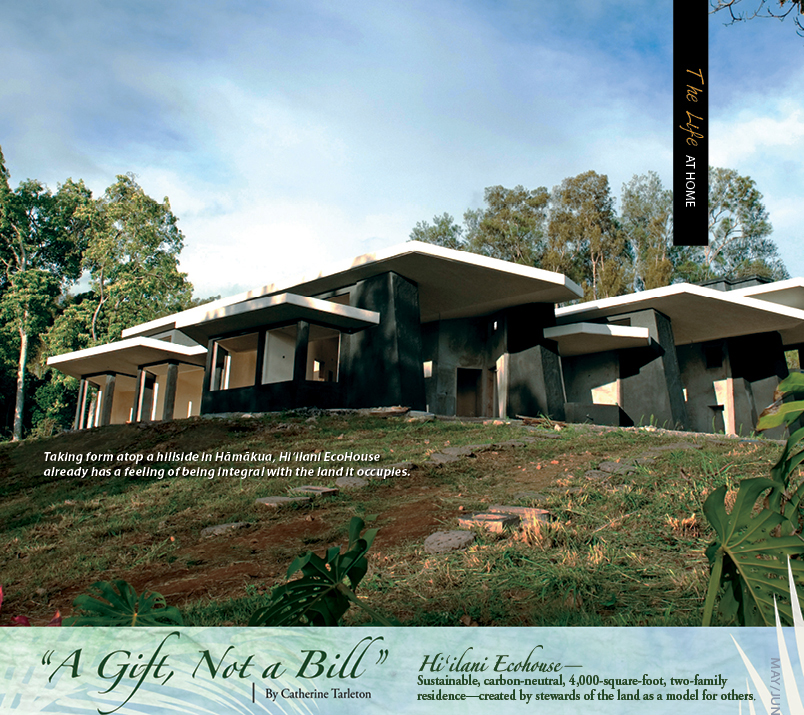
But when the road bends and the Hi‘ilani EcoHouse comes into view — its artful planes and gentle angles soft against the misty pre-sunset sky—we stop talking, catch our breath, and take it in. Hi’ilani means “held in the arms of heaven,” and this is even more than I anticipated.
Above its dark, dignified walls, white “butterfly” roof wings uplift to gather rainwater and sunshine and admit the tradewinds beneath. Window spaces frame the late-afternoon light everywhere: high and low, from spacious view-capturing overlooks to hidden skylights and small, louvered openings tucked under ceilings. Not too modern to be jarring, the monolithic structure and great geometric lines, bare of any decoration, make me think of Indiana Jones and a lost temple, secreted in the jungle-y tropics mauka of Kukuihaele.
If there is treasure here, clues to its discovery may be in back, where a bin of construction debris tells the story. There is not a stick of lumber in sight, no cases of nails or piles of cinderblock. Instead, various pieces of EPS (extended polystyrene foam) and rolls of wire mesh indicate this is “SCIP” technology (structural concrete insulating panel), and these foam panels with sprayed-on concrete skin are the walls and bones of this remarkable house. Linked together with wire mesh and rebar, making for strong, well-insulated walls, the SCIP is completely recyclable and carbon-neutral. In other words, whatever carbon dioxide is produced in its manufacture is balanced by the amount of energy to be saved in the future.
This is the Hi‘ilani EcoHouse, an invention — a collection of inventions — from smart people who care about how they live, with the foresight to want to pass future generations “a gift, not a bill.”
The Vision Takes Form
I met Robert Mechielsen four years ago, on what was to be a quick interview in Starbucks at the Kings’ Shops. Knowing next to nothing about architecture, besides reading The Fountainhead, I was surprised at the depth of our conversation. Four years later, when Dave and Sherry Pettus and Jim and Teri Sugg invite me to see the house, it feels like some kind of a time warp, a momentous one.
“When we met before it was a dream, a vision,” says Mechielsen. “This is really one of the first in the world’s history—a completely different way of thinking about architecture.”
We haven’t gone up to the site yet. We are standing in the living room of Dave and Sherry’s current, nearby house. Mechielsen starts talking and I whip out my notebook. He speaks in complete paragraphs; I don’t want to miss a word.
“The house is about almost creating skin to live in,” says Mechielsen. “We see architecture as fashion, like clothes, but without architecture, we can’t exist. The snail, the crab, certain corals and other beings, they are naked and need housing, but they know how to make housing. They know how to make housing that doesn’t kill their neighbors, doesn’t pollute… As we grow, humanity, our consciousness can come to do that as well. This may be an era where technology and spirituality are merging.”
Whoa. Sherry slides a chair behind me, sets a glass of juice on the table.
“For example,” he continues, “We can talk about housing that produces everything the house needs by itself – electricity, water, air conditioning, air flow, just by smart technology.”
“And nature,” Teri adds.
“And nature,” says Mechielsen, “and the desire to absolutely not pollute or be harmful to others.”
How is a house harmful? Ah. Construction waste in landfills, polluting chemicals in water systems, carbon dioxide from burning fossil fuels to create the materials. I get it. But this sounds very expensive. Will this kind of building ever be affordable?
“I think it’s coming in very fast,” he says. “My company in Holland (C-N Tech) deals with carbon neutral technology, and if you look at it, the price of oil dictates energy cost.” He holds up his hands, crossed in an X. “It’s like this,” he says. “Oil goes up as the price of renewables goes down. It could level as soon as 2013.”
Whoa again. Working together, the group discovered they had the interest and skills to create an eco-friendly home they really wanted to spend time in—a shapely environment that would also demonstrate their shared earth values.
Inspiration in Partnership
Dave and Sherry Pettus have lived in Honoka‘a for 17 years, giving the island the Hāmākua Music Festival and supporting numerous other community organizations and good causes. Longtime friends Jim and Teri Sugg visited often from the Mainland, attending the Aloha Music Camp on Moloka‘i and in Kailua-Kona. Teri’s an artist; Jim is a musician, computer professional, and a developer of Avid video and audio production technologies.
As conversation grew into conceptualization, they decided to build a home together—one that would not only accommodate the two couples and visiting family, but elder parents and all the things they love: music, art, technology, entertaining, great food, gardens and reverence for nature. Along the way, they connected with the Pachamama Alliance, which reinforced their commitment to rethink ways to live, work, eat and play sustainably, without robbing future generations of resources. This led to the idea of Hi‘ilani EcoHouse.
When he visited the site, Mechielsen realized the tradewind pattern, the path of the sun and the sightline to Maui intersected at three, 120-degree angles, making it easy to conceive a hexagonal structure. “The look of the house is dictated by the resources,” he said. “We are creating maximum capture of available natural resources: the view, the wind and solar energy.”
“Rarely do 90-degree angles occur in nature,” says Dave. “Instead, the 120-degree angles of the hexagon are what you see in coral, beehives, crystals, snowflakes. It is the strongest natural structure, and it is the natural shape something wants to take if it is well and happy, according to Dr. Masaru Emoto’s work with ice crystals.”
The four owners visited the “Hanna-Honeycomb” house in California, designed by Frank Lloyd Wright in 1937, and it solidified the idea. “The shape was inspired by the site,” said Teri. “If we’d done it any other way, it wouldn’t feel right.”
The Tour
“This is the music room,” Sherry says, beginning the inside tour. An elevated niche for performers leads down into an entertainment room, open to the ocean side of the house, terraced for theater-like seating. You can see the parties here, hear music, tinkling glasses.
Above is the kitchen with its hexagonal island and windows surrounding us, leading to pantry and laundry, more rooms clustered around a central courtyard open to the stars at night. Walking through the house, every view is different. Even bare and unfinished, each hexagonal space has a personality.
Teri’s favorite is the ‘ohana room. “It’s going to have a dreamlike quality,” she says. “It’s going to be cavelike, womblike.” For Jim it’s the “brain,” the electronic hub of alien wires and panels vine up from the floor, reaching tentacles out into the house.
In the heart of the home, Sherry’s office gives her a view of the driveway, the kitchen and the entertainment area, from where she can be aware of what’s going on in the main areas at all times. “That was my request,” she said, “That’s my favorite.”
At first I thought Dave’s place was in front, in the music room, where two wood stanchions mark the spots for his stereo speakers. But up on the roof, he takes a sea captain’s stance, hands on hips, smile widening, watching the sweep of treetops down to glittering ocean. Mechielsen too is at home here — stomping to prove the roof’s strength, jigging and sweeping two-arm gestures, in a kind of silhouette hula for my inadequate camera.
From up here, we peek down through skylights into the baths and kitchen, we marvel at the bright white shell that guides rainfall into the 24,000-gallon catchment tank, reflecting the sun’s heat. The slope of the roof, the “butterfly” effect that catches sun, rain and tradewind, is disorienting at first, but it’s easy to see what Mechielsen had described before.
“Trades blow through cool night air, creating negative air pressure like a bird’s or a plane’s wing, and stores the coolness in the concrete. Solar-powered fans blow it down in the daytime. It’s a ‘thermal mass battery,’” he said.
Sounds magical, but it’s not magic. There are, of course, thousands of technical details, all available at their website, but basically what they intend for their house is this simple:
- The home will be carbon-neutral.
- The occupants become autonomous. They don’t need companies with government subsidies and military powers behind them for their energy resources.
- It restores power generation to the homeowner, away from the utility company.
- Energy becomes a fixed, guaranteed expense. Jim says, “Developing of carbon-neutral design has huge political and economic ramifications.” Whoa. What the power of a vision and a motivated group can do.
The Idea Laboratory
All this green technology gathered under and on one roof has created its own “beta testing” site for numerous products and services. Because of interest generated in the project, Dave created the “Idea Laboratory” to welcome strategic partnerships and incubate new concepts.
“The Idea Laboratory is the culmination of the many innovative minds that have come to this land with the goal of creating a house that will reflect the most advanced thinking for years to come,” says the website. Hi’ilani was built with the idea of giving back, of being a base for education, and for new thought that brings a renewal of the spirit into living kindly on the Earth.
Built on some of the most exciting technologies, expansive new thinking, and strategic collaborations with manufacturers of products in test stages of development, EcoHouse serves as a proving ground, to authenticate and improve new technologies. Companies which are sharing innovation at Hi‘ilani EcoHouse include Tridipanel, Studio RMA, Breezway, Carbon Neutral Technologies, Hydrostop, HPM Building Supply, ABC Supply Co., Inc., California Building Specialities, Western Window Systems, epOxyGreen Design Center and others.
Dave and Robert welcome inquiries and are happy to host site tours for interested groups and individuals with notice.
Anticipate being delighted.
Contact Hi‘ilani Ecohouse
Pachamama Alliance Awakens the Dreamer
Architectural photos by Sarah Anderson

Catherine Tarleton
Cathey has been a freelance writer on the island since 2007, following a long career in the visitor industry. She is a regular contributor to Ke Ola and other Hawai‘i publications, and is the author of “Potluck: Stories That Taste Like Hawai‘i,” and “Mr. Mauna Kea,” a biography of longtime boss Adi Kohler. She encourages everyone to find the way to tell their story.